
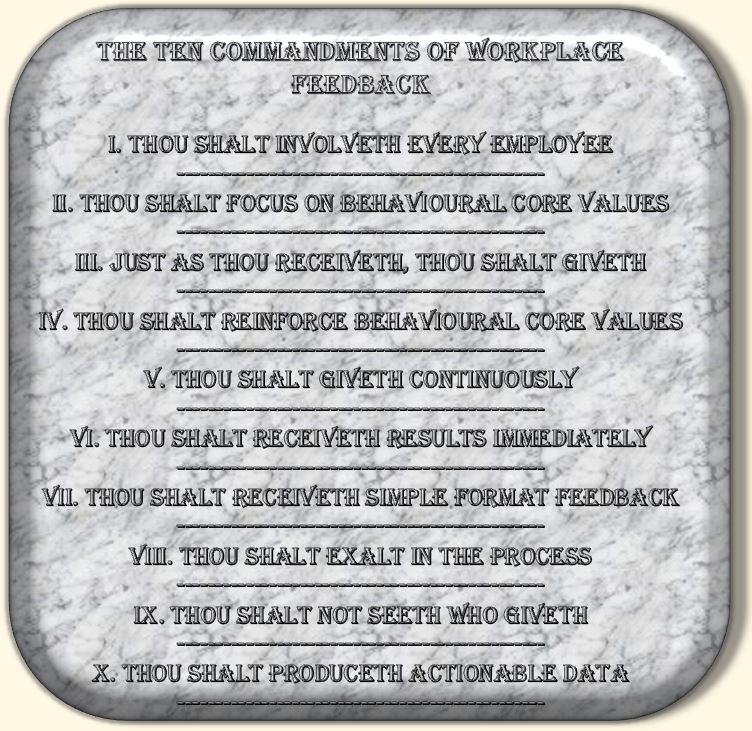
Feedback of any form is essential for personal growth. Constructive Behavioural Feedback will nourish your staff and help your workplace environment to flourish and it’s indispensable in treating any office Qualitosis. But when handled badly, feedback can be impotent or even destructive. Here we outline the 10 commandments to optimise workplace behavioural feedback systems:
1. Involve Every employee
2. Focus on Behavioural Core Values and how staff Feel
3. Rate each other 360°
4. Design to Reinforce Behavioural Core Values
5. Record Data Continuously
6. Give Timely Feedback
7. Keep it Simple
8. Make it Fun!
9. Respect Anonymity
10. Deliver Actionable Data
1. Involve every employee
Democratise the process. Company culture is the result of all the interactions between all the employees, not just the management. A rotten apple at any level of the barrel can spoil the batch. The rot quickly spreads far and wide and is hard to reverse, so everyone needs to be involved the feedback process.
It is understandable that in the past, a feedback initiative would be exclusive to higher level executives. The expense and the need to optimise the return on the investment on consultancy would necessitate this. Nowadays, with the advances in technology, this no longer holds true. By leveraging Apps and smartphones, everyone can contribute and benefit without any significant financial or workload burden to the organisation.

2. Focus on Behavioural Core Values and how staff feel
Behaviours are what makes the difference about how we feel at work. It’s not enough to provide a pool table and Friday donuts. If we’re serious about improvement and not just looking for a “tick box” solution, when we’re looking at bettering our workplace environment we must focus on behavioural improvement and reinforcing the core values that lead us there.
When we talk about core values, we should not confuse corporate core values with behavioural core values. Many companies have published corporate core values such as Innovation, Learning or Customer Service. Whilst these may be important values from a board perspective, no one – except perhaps a director – ever said “I had a bad day at the office, honey. Our levels of innovation really sucked today”. What we actually say is “I’m not sure I can spend another 4v*&ing day working alongside 4v*&ing Jim. He makes me feel so 4v*&ing angry and demotivated”. Considering that you’re already surmising that Jim has low levels of emotional intelligence (EQ), it’s unsurprising that Core Behavioural Values will necessarily be close cousins of the pillars of EQ. The best examples of these are Trust, Teamwork, Empathy, Appreciation and Motivation. Levels of these values should be used as key measures and be monitored in any behavioural feedback process.
And be careful how you frame your questions. Don’t ask your staff judgemental and potentially inflammatory questions such as “can John be trusted?”. Instead, ask them how John makes them feel – e.g. “does John make you feel part of the team…trusted…appreciated etc.?”, something that we are each in a unique position to answer accurately.

3. Rate each other 360°
There’s no doubt that the internet has revolutionised the way we connect and communicate. Networks are replacing hierarchies, empowering is replacing controlling. In networks, communication flows to and from all directions so we need peripheral vision to monitor relationships not just with direct managers but also with peers and subordinates. We can’t continue only to look up, keeping the boss happy for the quarterly review.
Efficiency used to be measured by by Taylorism and time and motion studies. That was fine when we worked on production lines in factories. Quality was measured in terms of waste and number of defects. Product quality was the key indicator. Those jobs have now largely been automated and/or shifted to low labour cost locations.
The developed world workforce has shifted to services. Now customer service levels are key and are where the focus needs to shift. Service quality KPIs are met through the effectiveness and motivation of the team. We know how much difference a cheerful, motivated waiter can make to a meal or a coffee, irrespective of the quality of the Java. Therefore we need multi-dimensional feedback to measure, monitor and improve how those connections are performing across all levels, locations and functions – from the general manager to the chef to the waiter.

And as a last important point on 360 feedback is that the act of giving feedback can trigger reflection about how we ourselves are perceived by others. In other words, both the receiver and the giver benefit from the process. It’s a two way street.

4. Design to intrinsically reinforce Behavioural Core Values
The Hawthorne Effect, also called the Observer Effect, is where people participating in studies change their behaviour when they are aware they are being observed. In scientific studies, researchers make efforts to eliminate this effect since they aim to calibrate normal patterns of behaviour, unaffected by the study. However, in the situation where the purpose of the exercise is actually to stimulate change (improvements) in behaviour and observation improves that, the Hawthorne Effect should actually be encouraged. For an extreme example, think how a crowd lifts the performance level of sportsmen.
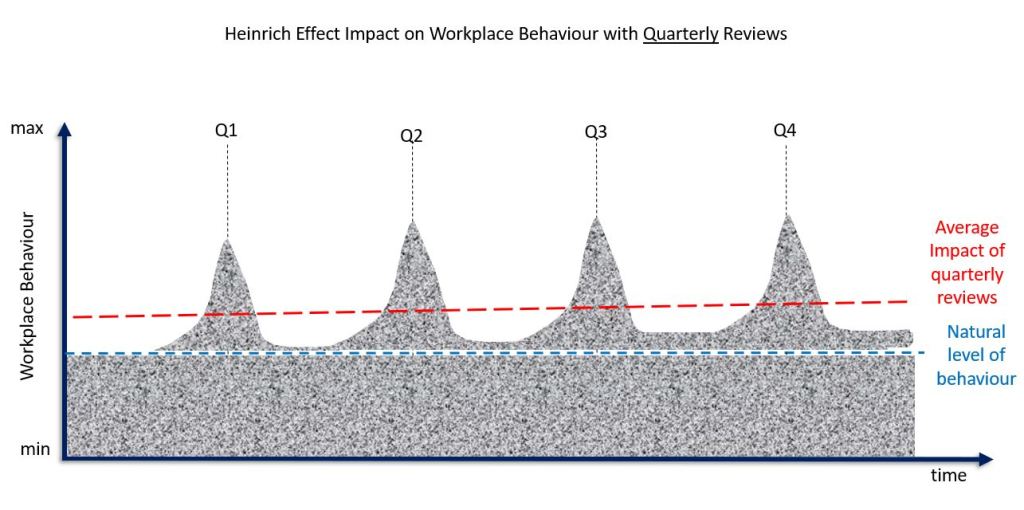
Once a survey is completed, that’s normally when the hard work for management starts. Results are consolidated and reported. An improvement plan must be developed and communicated to address areas of concern and weakness. Interventions and initiatives take place over the next few quarters after which the survey will be rerun to measure the impacts of the interventions. This is a management and administrative burden and often leads to the ultimate failure of the process due to insufficient resources. But if survey participation alone improves behaviour, half the battle is already won at this point and management has to do nothing more than encourage participation.
However, since this beneficial impact is transient (see chart) and behaviour will a largely revert to norm after the survey, it leads us to the next commandment and the benefits of continuous rather than periodic survey processes.
5. Record Data Continuously
Anyone who has observed an efficient athletic coach has witnessed an effective recording process. The coach continuously measures and records not only his/her athlete’s training times or distances but also diet, weight, working and resting heart rate etc.. Imagine if instead of recording data from each session or even each drill, she/he only documented it after each quarter or at the end of each season, attempting to remember the performances.
The results would be distorted by omissions and biases (giving more weight to recent sessions, for example), significantly diminishing the accuracy and value of the data.
The same happens when we give periodic behavioural feedback. Our responses tend to be distorted by recent events that are fresher in the mind. The best way to avoid this is to maintain a regular log.
Whilst this conjures up images of stopwatches and clipboards, the advances in technology have meant that monitoring and reporting have been dramatically improved.

This significantly reduces the administrative burden on the coach and the same can be true for a well-designed behavioural survey system on your HR administration.
Furthermore, a system that is designed to monitor, measure and report continuously (using integrated App/Analytics) can simultaneously act as a survey and improvement tool, significantly reducing the management burden. We have seen dramatic improvements in workplace behaviour through use of survey tool alone and no additional management initiatives. Consider how wearable technology, such as Fitbit, manages to not only monitor your fitness but raise awareness of your condition and motivate improved attitudes to exercise and diet.

If we apply the concept of continuous data monitoring to the impact of the Heinrich Effect or Observer effect, it acts by maintaining peak levels of focus throughout the year rather than just quarterly or annually.

Where we are attempting to change hard-coded behaviours, new habits need to be formed, which requires continuous, repetitive reinforcement and not just a New Year’s Resolution.
6. Give Timely Feedback
Feedback is not just for Christmas either – or for each quarter for that matter. The “latency”, or delay, of feedback is an important in the survey effectiveness. The longer the latency, the less likely you are to take corrective action in time. Imagine if the tennis coach waited until the end of the quarter or an annual review to give his feedback to his pupil? If we are serious about changing and improving behaviour, feedback should come as soon as possible allowing modifications to be immediate and more effective, while the observed behaviour is still fresh in the mind.

7. Keep it Simple
The greatest improvements in self-awareness require no more than a nudge or a wink from someone else… just to get the mind ticking. For maximum results, democratise the process by keeping feedback simple so that it’s enough to trigger self-reflection in all staff. For most, indexes or grades will be more than sufficient to stir some introspection.

8. Make it Fun and focus on the Positive!
We have all suffered at some point from survey fatigue, especially from those dull Likert scale “on scale of one to ten, how do you rate…” surveys. We understand they had to be that way in the past, but with new app technologies and smartphones that’s no longer the case. The more fun and interactive the survey, the higher the participation. The higher the participation, the better the results. “Gamify” the process as much as possible so it feels more like fun than a survey. It’s a critical element in your success. Focus on positive behaviours as well as addressing the negative and celebrate the wins!

9. Respect Anonymity
Where behavioural surveys are concerned, anonymity engenders honesty by eliminating the risk of confrontation or repercussion and keeps it impersonal. This doesn’t mean there isn’t a place for regular one to one behavioural feedback, but even in this situation, the conversation should still be impersonal with no “He said, she said” discussions.

10. Deliver Actionable Data
Not everyone will regularly give or look at their feedback and even if they do, there will be those who either cannot or will not change their ways. As part of good corporate governance, your feedback process should allow a responsible official to track overall indices and where necessary identify risks and hotspots such as bullying, harassment and mobbing so they can be addressed before they become issues.

In Summary…
Follow these 10 commandments when you design your workplace behaviour feedback system and you will develop an efficient solution to instantly and continuously improve the office culture and wellbeing of all your staff. Go for it!
 Qualitosis
Leave a comment