- There are distinct similarities between our behaviour on the road and our behaviour in the workplace
- Huge advances have been made in road safety over recent decades through behavioural improvements as a result of social and self awareness initiatives and tools.
- We deconstructed these improvements in terms of the behavioural catalysts behind these initiatives to be able to apply these same concepts to the workplace environment
- Finally we show how these concepts have been in applied successfully in a functional tool and system to make significant improvements in workplace engagement and attitudes.
In our blog “It used to be just physical but now it’s getting emotional” we discussed how physical safety in the workplace has historically received more attention than emotional safety because the consequences of failures in emotional/psychological safety are less visible. However, being less visible doesn’t necessarily make them any less significant.
In this blog we will look at the significant progress made in another area of physical safety – road safety – and via behavioural references will draw parallels to show how we can learn from this template to improve emotional safety in the workplace.

You are how you drive
In his article, “How You Drive Reveals a Lot About Your Personality [People who are obnoxious on the road are usually just as obnoxious (or worse) at work]“, Geoffrey James describes an ex boss to illustrate the parallels between how people behave behind the wheel and how they behave at work.
“When he was out on the road, however, he was a holy terror. He used his radar detector to go twenty to thirty miles over the speed limit, often while smoking a cigar and talking on his cell phone. A multi-car pile-up waiting to happen…His driving provided a glimpse of who he really was and if I’d driven with him before he offered me a job, I would have turned it down.”

The reason there are so many clear parallels between our driving behaviour and our workplace behaviour is that both depend on our levels of emotional intelligence and, in particular, our self awareness and social awareness. If you don’t care about the welfare of pedestrians and other drivers, why would you care about your colleagues?
Why aren’t there more pile ups on the road?
I would venture that every office has at least one character like Geoffrey’s ex boss – Let’s call him Mike. And often they exist high up in the organisation. Why? Because those personalities, both on the road and at work, do everything they can to get in front of others, irrespective of the risks they take and how many others they have forced off the road. Mike gets “results”. What upper management doesn’t see is the impact Mike has on everyone around him.

So with all these “Mikes “on our roads, why don’t we have even more accidents? What has society done to reduce the risk of certain individuals causing serious incidents and make them behave better on the roads?
Heinrich’s Triangle – It’s Statistics
Heinrich’s Triangle was first proposed in 1931 and since then has been a cornerstone of 20th century workplace health and safety philosophy.
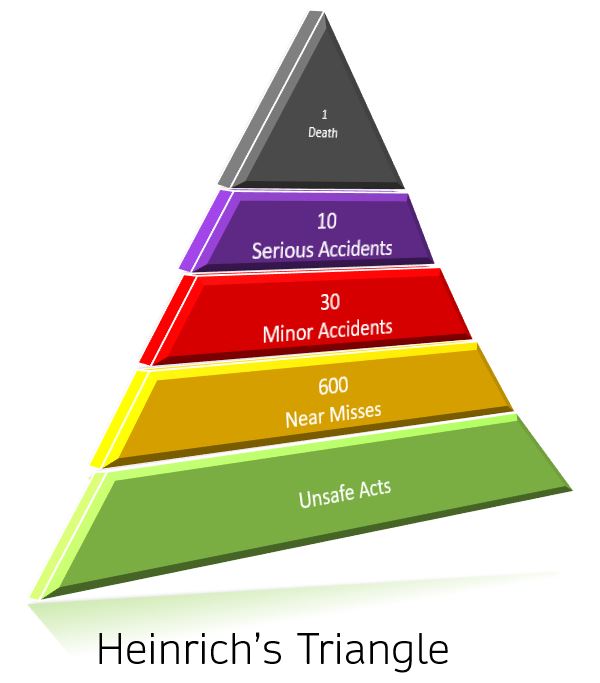
Applying the concept specifically to road safety, it maintains that if you can reduce the number speeding, drunk or aggressive drivers, you will proportionately reduce the number of near misses, minor accidents, serious accidents and, ultimately, catastrophic accidents.
So how do you reduce the number of speeding, drunk or aggressive drivers?
Physical or Emotional Restraint?
The most efficient and practical way to reduce risky behaviour is to is to appeal to our Emotional Intelligence. Given sufficient levels of social awareness and self awareness, drivers have shown that they will display sufficient levels of self management to drive in a responsible way. In the vast majority of cases, if someone is aware they are risking hurting another through a certain behaviour, and they are made aware that they are behaving in that manner, they will change their behaviour.
In the minority of cases where this is unsuccessful, physical restraints may be required such as speed bumps, speed cameras or even driving bans.
Over several decades a huge amount of resources have therefore been dedicated to improving both the social awareness and self awareness of road users.
Social and Self Awareness
To achieve lasting behavioural change, both social and self awareness must co-exist. In the case of road safety, various organisations will be tasked with educating drivers about the social reasons for improved driving behaviour. At the same time drivers need to be given the tools (feedback) to understand how they are performing against the metrics.

Social Awareness
Across any population, there is a broad spectrum of levels of instinctive empathy or social awareness. Most people reading this are likely to be on the empathetic end of the spectrum. Then at the other end, there are those who won’t even entertain the idea of reading the article and would dismiss it as “Woke rubbish”. Then there are those somewhere in the middle of the spectrum who wouldn’t understand the impact their anti-social behaviour has on others if it weren’t for the millions of pounds spent every year raising their social awareness.

To complicate things further, we don’t have a fixed setting. As individuals our position on the spectrum constantly fluctuates. Our levels of behaviour (if not empathy) are transient according to the situation. All of us at some point have been in a rush to get the kids to school or get to work on time. We need to be aware that the potential consequences of driving recklessly do not diminish just because the consequences of our delay may be increasing. A little bit more social awareness can always reinforce our self management skills! And it works….

Social Awareness Prompts
It’s not the same risk to drive at 70 mph next to a school in a built up area as it is to drive at 70 mph on a motorway. It’s also impractical to expect drivers to respect a 20 mph restriction on all types of roads and in all conditions. Therefore, over the years, maximum speed zones have been designated and the message reinforced with social awareness prompts such as school signs to help drivers adjust their speed according to the risk levels in that area and at that time. [Note the emotive use of the children on the sign.]

Recently, variable speed limits have been introduced where the maximum can be reduced to take into account different conditions such as ice, rain, accidents and lane closures or even school start and finish times.
Self Awareness
If you’ve ever had a broken speedometer in your car, you’ll know how difficult it is to accurately judge your speed without one. The speedometer is, in essence, a self awareness tool. It gives independent feedback (speed) on how you are performing so you can benchmark yourself against the social awareness measures (speed zones) to determine if you are behaving responsibly. Note that this is always the most prominent dial on the dashboard.

Self Awareness Prompts
Once the message has been communicated that excessive driving speed can have serious social implications, we often need prompts, or motivators, to channel our awareness to take action. These prompts can be signposts, speed camera signs etc.. Instinctively most of us when we see these prompts check our speedometers and reduce speed if necessary, though not everyone does…

Not All Drivers are Alike
Corbett (1995) identified 4 different types of drivers in their response to speed cameras – a) Conformers b) Deterred c) Manipulators and d) Defiers.
The Conformers are aware of the importance of safe driving speeds and would remain within the speed limit irrespective of the presence of cameras.
The Deterred moderate their speed in response to the presence of cameras. It is not necessarily the risk of being caught that deters them. The cameras, or camera warning signs, prompt the drivers to calibrate their awareness by checking their speed.
The Manipulators slow down in response to the cameras but speed away immediately afterwards. They are not motivated by social awareness of the risk they pose, only by the risk of penalty to themselves.
The Defiers are like manipulators in being most likely to drive company or high performance cars and they were most likely to deny a general link between speed and accident risk.
I would add another category here – the Unawares. These are people who believe they are Conformers but are not aware that they are speeding. These are actually the easiest to Deter as it doesn’t require additional education to change their behaviour, just self awareness.
Not unexpectedly, manipulators and defiers had the highest speeding and offending scores, and reported the highest speeds on the survey roads after cameras or signs were installed. However, it is important to remember that the vast majority of drivers fall into the categories of Conformers and Unawares. The aim of any initiative is to increase the proportion of Conformers and in turn reduce the number of incidents.
How Do We Translate These Lessons to the Workplace?
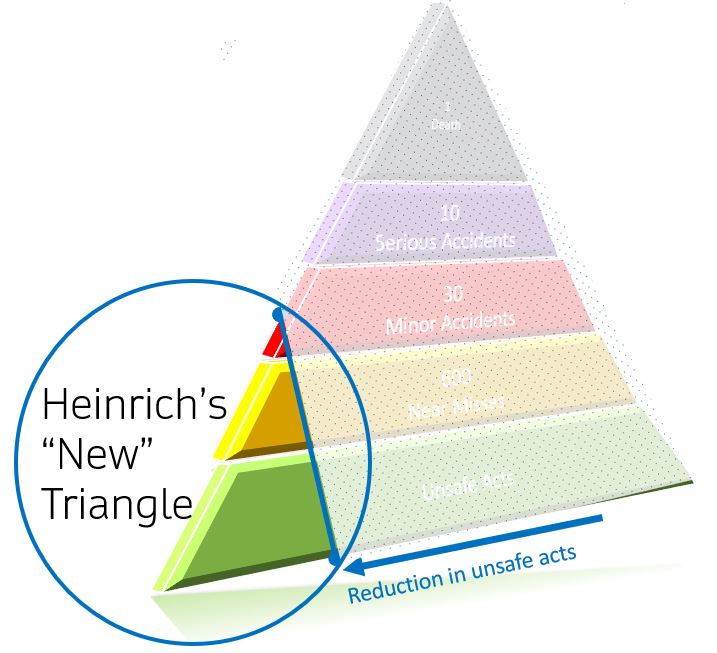
Firstly let’s translate Heinrich’s Triangle to apply to emotional rather than physical safety.
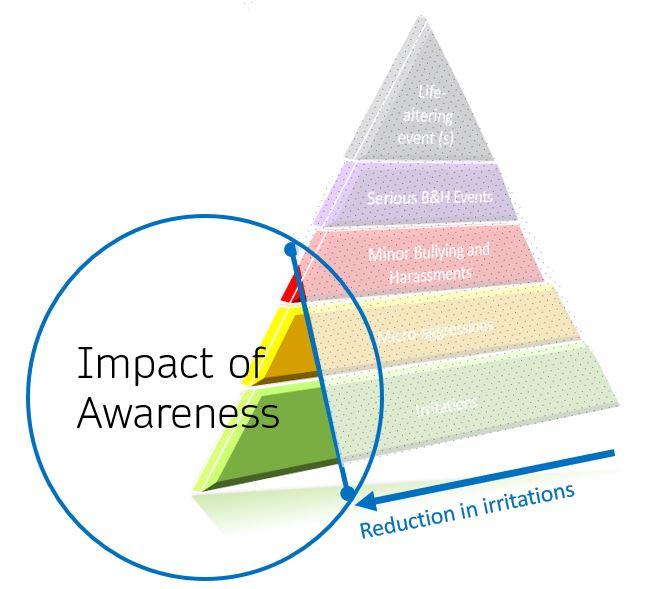
In the case of emotional safety, the lowest level (unsafe acts) translate as irritations, which can escalate to micro-aggressions, serious bullying and harassment and potentially a catastrophic consequence at the top of the triangle. Catastrophic events can manifest in a physical form but major legal or reputational issues can also be catastrophic for both individual and organisation.

In this framework, the application of Heinrich is that by reducing the number of irritations (see “Banter” below) we can reduce the micro-aggressions and incidences of bullying and harassment. Let’s not forget that most people are “good” people (see Results section later in this article) and if we do harm to others, it’s normally because we either weren’t aware of what we were doing or, if we were, we weren’t aware of the impact our behaviour was having on others. I.e. we are either conformers or non-conformers who are inclined to conform with just a little awareness nudge.
Conformers, Unawares, Deterred, Manipulators and Defiers in the Workplace
In the previous example, Mike is a clear Manipulator both on the road and in the office. To quote Geoffrey, “Mike’s driving behaviour revealed his true character: he didn’t care who got hurt as long as he got his way. And indeed, anyone who worked with him long term eventually realized that beneath the smiling façade was a sociopath”
We all know how much damage these personalities can do to the lives of their colleagues and to the long-term success of a busines. Conversely we know how being respectful to your co-workers is good for business.
If you haven’t seen the video below by Christine Porath, please grab a tea or coffee, click on the picture and watch and listen for 15 minutes…

In the work environment, the Manipulators are the ones who insult or depreciate others behind closed doors – but smile in public. The Defiers are those who are rude and abrasive in public but think they are too important or powerful to be accountable – and often are.
Jack Welch, long-term CEO of General Electric famously put it this way:
CEOs can talk and blab each day about culture, but the employees all know who the jerks are. They could name the jerks for you. It’s just cultural. People just don’t want to do it.
Jack Welch
“Neutron Jack” was probably right that it was “just cultural”. What might surprise him, however, is what is the cause of this culture where poor behaviour goes unreported and why people don’t “want” to report it. The above quote from Jack is actually preceded by “Public hangings are teaching moments. Every company has to do it. A teaching moment is worth a thousand CEO speeches.” That doesn’t strike me as an environment where staff would feel comfortable speaking out. After all, culture is set from the top, Jack.
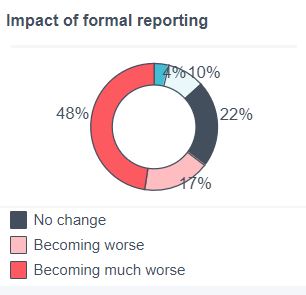
The General Electric under Welch is far from the exception. According to the Speak Out Revolution, it is five times more likely that a person’s experience will become worse from formally reporting bullying or harassment and in only 4% of cases did it lead to full resolution. With statistics like that, is it surprising that victims do not speak out?
Why is this?
(In)visibility of Poor Behaviour in the Workplace
As mentioned above, there are Conformers, Unawares, Deterred, Manipulators and Defiers in the workplace as well as on the road.
And as with improved road behaviour, the aim is to increase the proportion of Conformers and Deterred staff and, in turn, reduce the number of incidents. However, whereas the consequences of failures in emotional/psychological safety are less visible, the incidents that lead to them are almost completely invisible. With speed cameras it’s quite simple to identify and quantify infractions – it’s binary – you’re either speeding or you are not. However, according to the Speak Out Revolution, the most frequently reported form of harassment and bullying is gaslighting. It can also be argued that most of the remaining behaviours on the list are also subjective and hard to substantiate and prove, even with witnesses.

Furthermore, 56% of respondents have experienced incidents where there are no witnesses at all.

Beastly is in the Eye of the Beholder
As Cristine Porath puts it, “What’s uncivil to one person may be absolutely fine to another”. It’s not just invisible then, it also can look completely different depending on the perspective of the viewer.
To illustrate this, again using data from Speak Out Revolution, 26% of reported that the sexual harassment came in the form of “banter”.

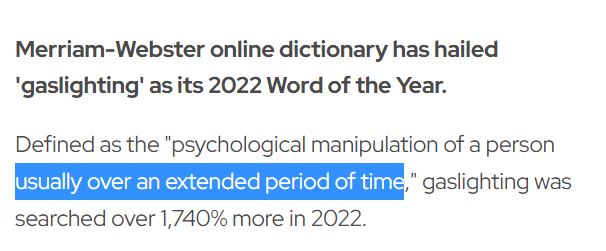
What to one person may be “playful” and “teasing”, can to another be harassment and offensive. Look at the definition from Websters:

So not only are acts and consequences of incivility largely invisible, they are also highly subjective to the individual experiencing them.
It’s as if when we’re setting safe speed limits in the work environment, it depends not just on the roads but also on the sensibility of the other drivers and pedestrians at that time and in that place – like sensitive variable speed limits. Each one of us has our own perception of what is a safe speed for others – and we are all correct because if they are alarming us, they are driving too fast in our presence. That’s complex.
Straws and Camels
If the roulette wheel has come up with 3 reds in a row, it doesn’t mean the next spin is more likely to result in a black (see Gambler’s Fallacy).
Similarly, Heinrich’s theory is based on bald statistics. If there’s a 1% chance of an unsafe act leading to a near miss and a 0.01% chance that it will lead to a minor incident, that doesn’t mean that if the unsafe act has been repeated already 9,999 times without a near miss that the next unsafe act will be 100% likely to result in a minor incident. The system does not have a memory. The roulette wheel does not know the last spin was a red. The statistical slate is wiped clean before each spin.
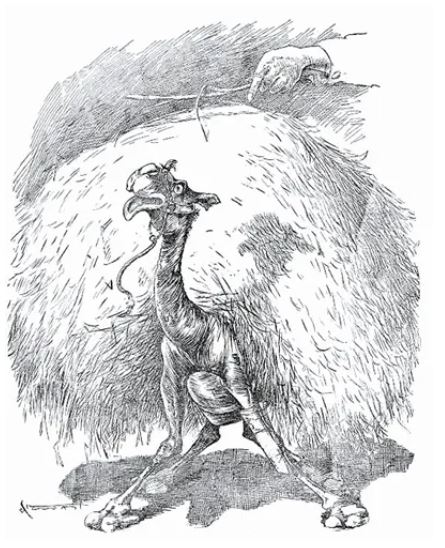
This is not the case with human interactions. We do have memories and a small action repeated many times increases the likelihood of a more serious event occurring the next time that act takes place. It’s the last straw that breaks the camel’s back, the final drop that bursts the barrel. The damage is often a cumulative effect over an extended period of time.
Most times we are not aware of the straws a colleague is already carrying. Furthermore, they are likely not straws that we ourselves placed there and even may have mounted up outside of the office. Sometimes we are not even aware that we are burdening our colleagues with straws. Ultimately it comes down to our levels of Social Awareness and Self Awareness.
This cumulative factor is another reason why bullying and harassment is so difficult to resolve through formal channels. Because if a single straw breaks someone’s back, it must be that the back was weak, yes?
This can be illustrated graphically by the Exponential Law of Reactional Returns. Anyone who has an elder sibling and has been in the back of the car on a long journey will understand it…
At first we might not even notice the irritations, and once we have noticed them we are temporarily able to control ourselves. However, if there is no reduction after some time, there is likely to be an uncontrolled response or “blowout”.

We know what happens next…Mummy wants to know why Jessica lost her temper and bit Johnny’s arm. And this is the result of her “review”:

“It was just a drop of water and she just flipped. She’s crazy”…

Ideally there should be a system that can monitor, reveal or better still, prevent, the drip, drip, drip that represents the base of Heinrich’s triangle. If we can eliminate most of the irritations in the unaware and control phases, we will never reach blowout.

Because of the exponential nature of the reaction to cumulative irritations, a halving of the number of irritations doesn’t just reduce serious reactions by 50%, it can completely eliminate them.
In her Ted Talk, Christine gives the following results of her survey of the consequences of uncivil behaviour in the workplace.
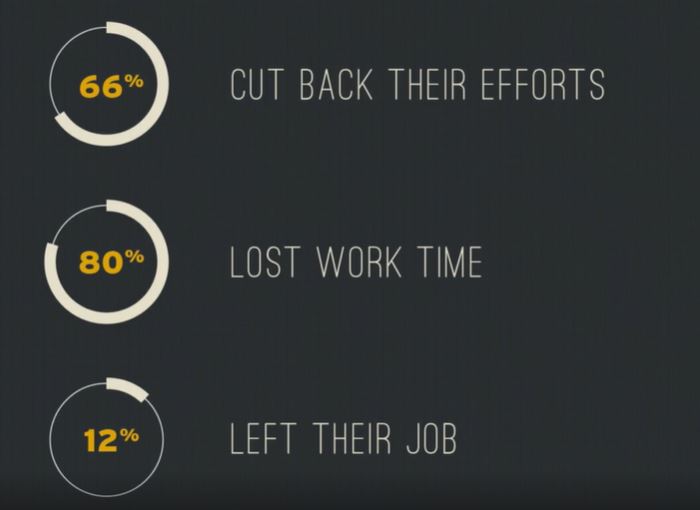
Little wonder then that the cost impact of uncivil behaviour is also exponential.

Social and Self Awareness in the Workplace
As we saw earlier, behavioural change happens when Social Awareness meets Self Awareness. One without the other doesn’t work effectively – like a speed zone without a speedometer or a speedometer without a speed zone. In the case of the work environment, the responsibility for raising social awareness about the consequences of poor behaviour lies with management. As we’ve seen, it’s not just a social responsibility. Managers have a professional responsibility to improve the efficiency and effectiveness of their teams and this requires raising awareness that uncivil behaviour has consequences … and will not be tolerated.
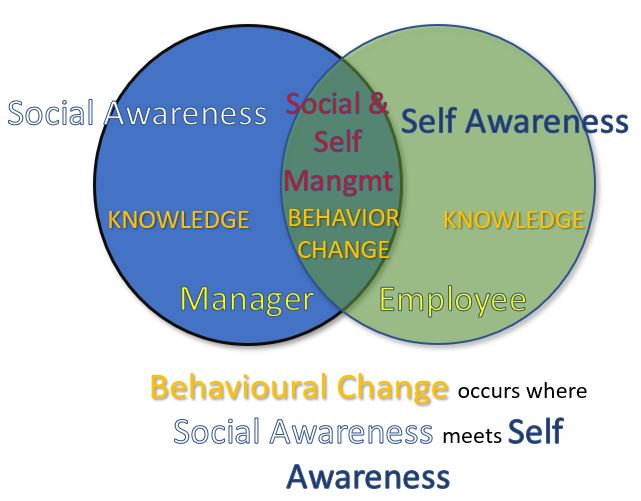
Successful managers will communicate to their teams, both verbally and through actions, to increase social awareness of the importance of civil behaviour in the organisation. They will also encourage participation with feedback tools for staff to help them increase their awareness on how they are behaving against the standards expected. This two-pronged and co-ordinated approach accelerates, maximises and embeds the behavioural change.

Social Awareness in the Workplace
What is Social Awareness? In the Blog Removing the Gobbledygook from Goleman’s 5 Competencies we see that Social Awareness in the workplace flows from Empathy with your colleagues:
Empathy with others’ feelings.
Empathy with others’ situations
Empathy with others’ perspectives
Empathy with how your your actions and attitudes affect others
You could say that it’s all about sensing to what extent our colleagues are burdened by straws and understand what they (not you) might consider to be straws.
For some people, empathy comes quite naturally. For others it requires a certain level of education and enlightenment. However, Emotional Intelligence can be learned, so it’s not a lost cause.
To this end, just as organisations have raised awareness of the serious consequences of antisocial behaviour on the road, the same is evolving for behaviour in the workplace. For example, the recent ISO 45003 incorporates psychological safety as well as physical safety. In several countries pressure groups such as Conduct Change are not only raising awareness but are also successfully pushing for measures to be built into legislation.

Part of the process is explaining to business owners and managers that bad behaviour in their workplace is not just damaging people’s lives but also damaging their businesses [Qualitosis] and that action needs to be taken to diminish it.
In 2021 ACAS calculated the overall total annual cost of conflict to employers in the UK (including management and resolution) at £28.5 billion. This represents an average of just over £1,000 for every employee in the UK each year, and just under £3,000 annually for each individual involved in conflict. It points to a clear link between the wellbeing of employees and organisational effectiveness.
Cristine Porath describes incivility as a bug or a virus as it can spread so quickly if unchecked.
It can also be compared to the growth of weeds as its presence often appears only once the roots are set deep and it is hard to remove, by which time seeds have spread and the roots have choked the benign plants around.

So why is it still so difficult to achieve the necessary change?
We don’t have behavioural speed limits or signposts
Everyone has different levels of tolerance to poor behaviour. For one person what’s banter to another is harassment. Furthermore, these tolerance levels can change significantly in an individual over the course of a year, month, day or even hour. So what are safe levels of behaviour? The answer is that if it’s causing distress to someone, it is not safe to that person. But how do you measure that before it’s too late, a reaction has occurred and damage has already been done?
Self Awareness in the Workplace
We don’t have workplace behaviour speedometers
Even if we did know what the safe speeds are, we are not great at assessing the impact of our behaviour without some form of independent feedback.

The larger and more diverse the team, the harder it is to understand how we are impacting each other. In the days of Jack Welch, it wasn’t so complex – as if you were in your car driving in single lane traffic. As long as you kept your distance from the car in front (your boss) and didn’t brake too hard on the cars behind (your subordinates), you were probably going to be fine.

Add to that the fact that your office was likely to be populated by white ,middle-aged men with similar views and prejudices, and office life was simple. A quarterly or annual review and maybe a 5 year 360° review for senior managers and you could be fairly sure you were on track.
The office environment is very different today. With diversity, high speed communications and remote working, we need 360° awareness every day to keep up, not every decade. And due to the exponential growth of networks over hierarchies everyone can have an impact on anyone, no matter what grade level or job title they may have. So we now need that awareness for all staff, not just for executives.
Organisations which fail to evolve will gradually become obsolete as their best staff leave and efficiency and profits are eroded. Those which do evolve, however, will thrive and replace them in a drawn out process of creative destruction.
Unfortunately, whilst this process unfolds over many cycles, millions of employees will suffer unnecessarily the consequences of poor workplace behaviour.

The Solution
In 2018, we set about to find a solution to the issues we have discussed above. We believed that if we could harness the very technical advances that have enabled today’s workplace complexities we could raise both social and self awareness and accelerate the behavioural improvements that are required to improve workplace environment and efficiency.
The “Speed Camera”
How can we have the equivalent of a speed camera in the workplace to tell us how we are doing? Especially if, as we discussed, the unsafe speed depends sensibility of the observer and that can fluctuate significantly from day to day.
The answer is to have a system that can be used by everyone to give feedback to anyone, every day of the year. A “360 x 365” system.
We called it the Sentemeter

The aim was to create and test a behavioural improvement system for the workplace.
It would work by enabling continuous 360° feedback across any networked organisation in order to dynamically increase staff engagement and performance by cementing a better understanding of the impact of behaviours in all employees.
We didn’t want it to be cumbersome and time-consuming especially since colleagues should be encouraged to use it every day. So we made it quick, simple and fun, using emojis, images and swipe technology. Essentially we harnessed the technology used in dating apps.

To give feedback to your colleague (e.g. Bono in this case), you just swipe the relevant emoji over the profile picture and it will move on to a new colleague. This way you can give feedback every day to your closest 30 colleagues in a minute and to 100 colleagues in less than 5 minutes.
Prompted by the appearance of a colleague’s profile, the App asks just a single question, “How do you feel about me today?” There are 10 possible answers, each one represented by an emoji – 5 positive emojis and 5 negative emojis. The wording of the question is carefully constructed and is different from traditional 360° questions in that it deliberately asks how you feel.
To understand the importance of the wording, imagine that your colleague has just driven you to the client at breakneck speed through traffic. On arrival he/she asks you, as you extract your fingernails from your thigh, “Do you think I am a safe driver?” The question is inviting an opinion – and opinions are debateable, especially by aggressive personalities. So the chances are you will brush off the question as you dash to the washroom. But if you do summon up the courage and answer “No.”, the response might be “I’m a qualified Advanced Driver and I’ve never had an accident in 30 years”. End of conversation and end of opportunity for increasing self-awareness.

Alternatively, if he/she asks “Do you feel safe when I drive?” the question is no longer inviting and opinion, it’s inviting a statement of fact. Therefore, it’s much easier to answer “Actually I was quite scared”. It’s not debateable. You own your feelings.You are the expert in that particular field. The driver cannot reasonably respond “No, you weren’t scared”. So it opens up the opportunity for some introspection.
The Speedometer
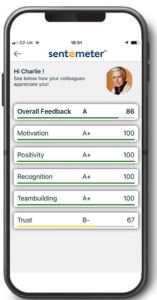
The premise of Sentemeter is that by making us more aware of how our colleagues are impacted by our actions, this new self awareness will naturally improve our behaviour. In terms of the above, we will increase the number of conformers and reduce the unawares, manipulators and defiers.
The feedback is received by our participants in the form of 30 day anonymous averages of the key EQ core values. This allows them to check where they are doing ok and where they should be more conscious.
The Self Awareness Prompts

If awareness is the key and awareness comes from feedback, how do you encourage staff to look at their speedometer?
We built a notification system to nudge staff into opening the App and checking their dashboards. It’s like saying you’re about to pass through a zone with cameras, check out how you are doing by glancing at your dashboard.
The Sentegram
We all appreciate feedback but especially when someone goes out of their way to say thank you. Sentegram was developed for this purpose.
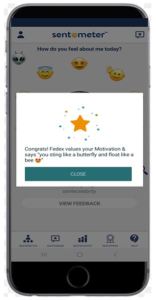
Staff can choose to emphasise which of the core values of Trust, Appreciation, Motivation, Teamwork or Positivity and leave a personalised note that will appear on the receiver’s phone.

Management Tools
In a hierarchical organisation, the manager is a link in a chain of command. Their job is to pass down instructions and ensure they are effectively complied with. Motivation to comply is created through financial incentives and promotions.
In a networked organisation, the manager is expected to build levels of teamwork and engagement. Motivation is created by a sense of camaraderie, shared successes, creativity and self worth. The exponential growth in networked organisations explains why there has been such a growth in the studies in employee behaviour and engagement.
In the networked organisation, the behavioural manipulators and defiers are therefore much more likely to destroy a team than they would do in a hierarchy.
Hence, managers need to be ever more aware of any bad behaviour amongst their teams and eliminate it at the earliest opportunity.
How can they do this?
Participation
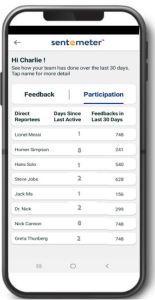
If using the Sentemeter improves behaviour merely though its use, it stands to reason that the more widely it is used, the greater the positive effect. That is why we focus most on giving management the tools to maximise participation.
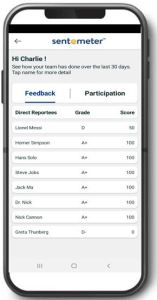
Within the App, managers can see if their direct reports have given feedback within the last 30 Days and nudge those who have lapsed.
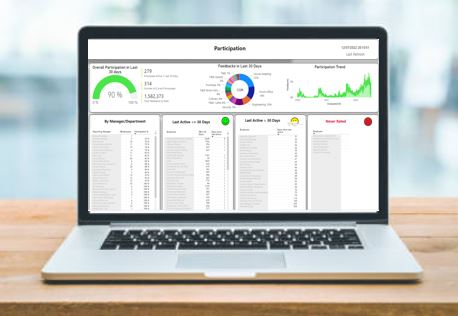
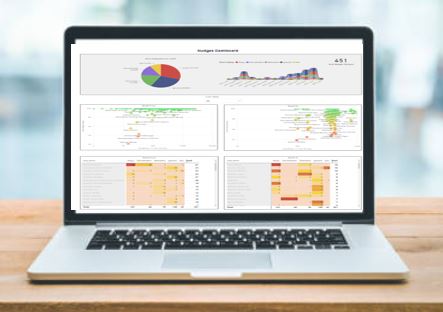
In addition, central HR management has access to on-line participation dashboards so that lagging managers or departments can be nudged to get their teams on board.
The Senteminute
Just as many organisations kick off every meeting with a safety minute, we encourage managers to start their weekly meetings with a Senteminute, where staff will take a minute to give feedback to their colleagues and consider how they are being impacted by their behaviour and vice versa.

Managing and Mentoring
Managers have a responsibility to ensure the behaviour of their staff falls within acceptable standards. They are not able to witness every interaction, nor should they, but they are able to view the indexes of their team members in the App to ensure there are no issues building. They use this information to help them direct, manage and mentor their staff and to raise their own awareness of their team’s overall levels of interactions.
Managing the Outliers
The vast majority or participants will conform to behavioural standards, especially once self awareness is increased. Also, the nature of the 360° x 365 solution (sunlight is the best antiseptic!) means that manipulators will instantly conform – provided participation is high and management is perceived to listen. However, there may still be staff who after several months are still getting or giving sub-optimal feedback. These defiers are staff who feel that the standards of the organisation don’t apply to them or think that they are smart enough to get away with it. Therefore there is a requirement for secure governance dashboards that allow easy identification of potential hot spots so these can be dealt with before a more serious situation develops. These dashboards help analyse the situation by identifying if the feedback is one to one, many to one, cross-gender, race etc.
It is not a Witchhunt!
One of the reasons behind the success of the driving safety campaigns is that they appeal to drivers’ sense of society. They appeal to the sense civic responsibility and do not emphasise the risk of being caught or fined (though implicitly it is there). Speed control initiatives that are perceived as being driven by a desire to penalise and impose fines lose the social influence and actually encourage manipulators and defiers. Similarly, if Sentemeter is seen as tool to sanction errant participants, it will lose its social authority.
Listening by Management
There are few things more frustrating to staff than to be given a Voice, but to find out there is no Ear.
If Management does not show that it is looking at the results of the feedback, participation will drop off dramatically. It would be like having a speed camera that flashes but doesn’t record or report. It doesn’t take long after people are aware of this before the positive impacts wear off.
It is important therefore that Management regularly communicates to staff the trending of the overall KPIs for participation and indexes and is also seen to intervene from time to time. Staff need to see the benefits of their involvement and feel they are being listened to and their voice is valued.

The Results
The system was introduced into a multidisciplinary organisation with an average of 300 staff, from 30+ nationalities and with 30 interdependent departments.
Over the 2 year period from 1st Jan 2021 to 31st Dec 2022 over 2m feedbacks were given by staff, i.e. around 3k/day with monthly participation by 75%-90% of staff.

In the most recent 28 day period, 66% of Android users had checked their personal dashboards a total of 940 times (6 times per user)

and 84% of iOS users had checked their personal dashboards a total of 1,180 times (10 times per user)

Android users averaged 1.28 sessions on the App a day with the average duration per session a little more than 3 minutes.

iOS users averaged 2.3 sessions on the App a day with the average duration per session just under a minute. I.e. they used the App twice as often in the day as Android users, but for a shorter duration.

At the beginning of the test period, 70% of the feedbacks were positive. By the end of 2022, more than 99% of feedbacks were positive with an average of 99.4% over 2022.

All core values achieved over 99% positive feedback by the end of the period, with the exception of Appreciation at 93% positive.

2.7k Sentegrams were sent by colleagues to each other during the period, with the highest reason selected being motivation. N.B. The increase in count from August 2022 coincides with the introduction of an automatic notification on receipt (social awareness prompt).

During the period, Human Resources needed to intervene on 4 occasions to resolve issues that were highlighted via the analytics.
There were zero situations where the use of the App led to an incident, e.g. where several staff or an individual decided to “Mob” another employee to artificially force down their indexes.
Conclusions
Staff appreciate having a Voice and this translates into high Participation
Participation rates (the “Voice”) were significantly and continuously higher than expected (Monthly average 80% vs expectation 45%). This can be partially explained by the ease and speed of use – note average session durations of 1-3 minutes. However, equally important was the impact of management participation and feedback (the “Ear”) .
Reported Behaviours Improved Significantly
The reduction of negative feedbacks from 30% of the start of the exercise to less than 1% at the end, illustrates a significant reduction in negative behaviours – probably through increases in Self Awareness. This conclusion is backed up by anecdotal evidence from staff. It is difficult to quantify the direct business impact of the change but it is also likely to be significant in terms of improved efficiency and engagement and reduced staff attrition.
Self Awareness Increased
The frequent use of the App personal dashboard (70%+ of users checking it each month) indicates that the system not only acts as a voice but as also as a mirror to raise self awareness through Feedback. This is not just a benefit to the organisation but also to the staff themselves.
Management non-productive workload can be reduced drastically with the right tool
Just as the presence of speed cameras reduces the number of speeding motorists which in turn reduces the number of accidents, an effective self awareness tool reduces the number of serious personnel incidents in the workplace by eliminating the escalating behaviour at source. This means that managers can focus their resources on building their teams instead of firefighting personnel issues.
We Sometimes Need a Nudge
The fact that the number of Sentegrams increased as soon as notifications were sent, shows that we sometimes need to be prompted to do a good thing. The notification spurs us to check the feedback and it seems the feedback spurs us to send feedback to another.
Improved behaviour starts with self and social awareness which comes from regular feedback. It’s catalysed by regular prompts or nudges until it becomes a habit. Once civil behaviour becomes a habit in the workplace, it becomes a better place for all.
 Qualitosis
Leave a comment