ISO 45003 and the path to better working environments & psychological health

You have to have been living under a rock if you haven’t seen how important a safe workplace culture has become. It’s not just about “wokeness” though. The recently published ISO 45003 (Psychological health and safety at work) is the first global standard giving practical guidance on managing psychological health in the workplace. It states “Effective management of psychosocial risk can lead to benefits such as improved worker engagement, enhanced productivity, increased innovation and organizational sustainability.” What’s not to like about that? It’s a win-win for everyone – staff, management and owners. So we have to ask ourselves why this hasn’t happened before.
The answer to that is threefold:
- It has, but only recently – and in a minority of companies (see Google’s Project Aristotle 2012).
- Traditionally managed companies don’t see the need.
- It’s not as easy as it sounds because we don’t yet have adequate knowledge or tools to achieve it universally.
This blog addresses the third point because we do have the knowledge and the tools, we just don’t know it.
We don’t have to reinvent the wheel
Back in the 1930’s, when academics were beginning to look at Occupational Safety, industry was fairly ignorant of the costs of work-related incidents. In fact, prior to this, there was little data available for the number of incidents, let alone the cost. As this data accumulated after 1930, managers began to realise that it’s not just unpleasant to kill your fellow workers, it also costs the company a hell of a lot of money.
We are not far off that stage now with psychosocial hazards. It’s only recently that academics have been quantifying in dollar terms how much toxic workplaces are costing organisations. And the numbers are truly shocking.
As a result, managers are being forced to wake up in the same way they had to in the 1930’s onwards.
The difference now is that they were starting from scratch, but we can learn the lessons from the advances in occupational health and safety and apply them to psychosocial safety – or psychosocial / mental health as it is referred to in ISO 45003.
A Brief History of Occupational Health & Safety
When making comparisons between Emotional and Psychosocial Safety, it’s helpful first to look at a brief history of Occupational Safety in the US. The Occupational Safety and Health Act was only approved by US Congress in 1970. But even before 1970 the occupational death rate in the US had fallen from around 40 to 18 per 100,000 workers, an astounding reduction of 50% in less than 40 years.

Heinrich & Bird
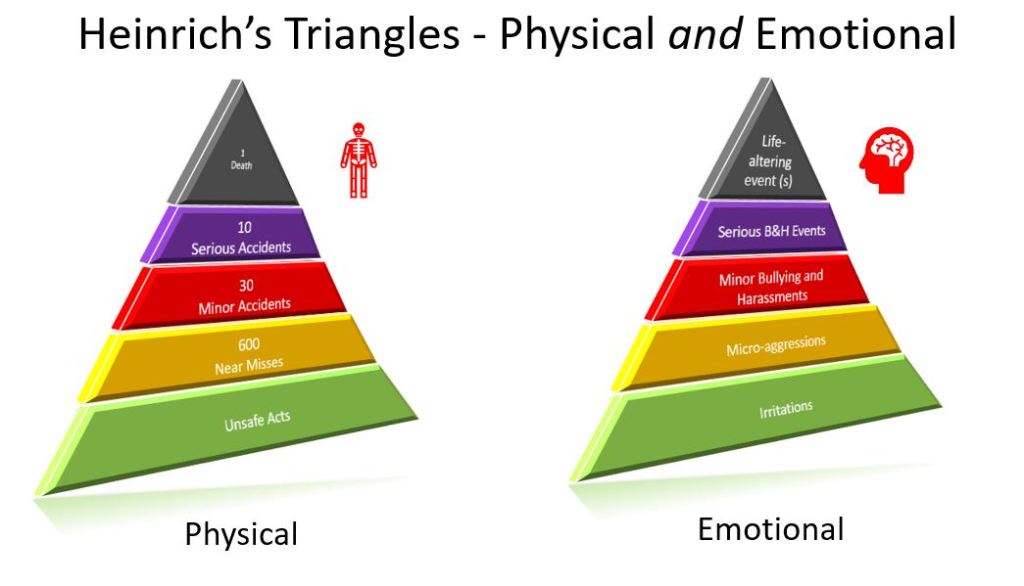
What happened to cause such an improvement since 1933? It’s no coincidence that Herbert William Heinrich proposed the accident triangle (also known as Heinrich’s triangle or Bird’s triangle) and his theory of industrial accident prevention in 1931. His theory shows a relationship between serious accidents, minor accidents and near misses.
Often shown as a triangle or pyramid, it has been described as the cornerstone of 20th century workplace health and safety philosophy.

The idea that underpinned the preventative approach is that by reducing the number of minor accidents, there will be a corresponding fall in the number of serious accidents. I.e. you don’t need to wait for a big incident before you take action.

Further work by Frank E. Bird in the 1960’s showed a relationship between the number of reported near misses and the number of major accidents. Therefore the number of accidents could be reduced by an appropriate intervention to reduce the frequency of near misses. You didn’t even have to wait for a minor accident, you could take action on the basis of near misses alone.
“I.e. if you can reduce the number of near misses by taking preventative action, then you will reduce the number of incidents all the way up the triangle and ultimately significantly reduce the frequency of, or even eliminate, catastrophic events.”
He also added an additional bottom layer to the triangle (in yellow in the diagram above) for observations of unsafe acts. The theory is that by reporting risky situations e.g. an oil splash or a broken ladder before a near miss could occur, less accidents will happen. You didn’t even have to wait for a near miss, you could take action on the basis of observed risk alone. It makes complete sense – provided systems are in place so someone actually takes preventative action .

Furthermore, if an organisation is able to make safety observations a habit, it is possible to instill a safety culture in both the individuals and the group and that culture persists even once the observation mechanism is removed. After all, you don’t stop brushing your teeth and washing your hands once you leave home and Mummy isn’t watching you.
Safety Culture can be learned
Back in the 1990’s I joined the finance department of an Oil and Gas services company in Venezuela. Two particular incidents still remain with me after all these years.
Firstly, there was a vehicle roll-over in a remote part of the country. The driver wasn’t wearing a seatbelt and as a result didn’t survive the accident. He died only because he didn’t spend one second buckling up. During the investigation it was found that the driver hadn’t undergone the required safety training before driving. The regional head of HSEQ was the first person to be dismissed.
The second incident occurred just a couple of weeks later when a newly-arriving expat went to view his accommodation with his family. As he set off, he didn’t fasten his seat belt. This was observed by a fellow employee and reported. The expat was dismissed.
These two incidents were shocking to me. At the time I felt that the punishment was excessive. However, over time I sensed my own behaviour change, insisting on checking on everyone being buckled up before moving. Just two months later a wheel detached from a car just in front of us on the motorway and rammed under our front bumper. The force punched us up on two wheels for what seemed an eternity. Fortunately we came crashing back down just meters from hitting the central reservation. We were lucky. On another day if we hadn’t all been wearing seatbelts there could have been catastrophic injuries to my young family and me. Spread across the organisation, the change in attitude brought about by the zero tolerance, “statement actions” and the awareness these bring, saved countless lives and saved many families from losing their loved ones. And from a corporate perspective, it saved hundreds of millions of dollars.
How does this apply to Emotional Health and Safety?
The Oil and Gas industry has been at the forefront of improvements in Occupational Safety due to the high potential impact of any failures. However, when talking about emotional health and safety, all industries and sectors that have employees are exposed to high levels of risk. You don’t have to look far to find shocking examples of bullying and harassment in sectors as diverse as healthcare, education, police & military, telecoms and government. Arguably these incidents cause just as much damage as do physical incidents, and collectively, much more.
Comparing the two, there are great similarities between physical and emotional health and safety. This is illustrated below by comparing two incident triangles, one the original physical and the other emotional.

The problem with invisibility
The essential and obvious difference between physical and emotional incidents is in terms of identification. The consequences of physical incidents are visible whereas in most cases the consequences of emotional incidents, especially those lower down the triangle, are invisible.
This makes emotional issues harder to spot than physical risks. Even when identified, this invisibility makes it easier for management to ignore.

The problem with quantifying
You can’t manage what you can’t measure, right? Being invisible, it is also harder to quantify the severity of an emotional event. It is made even more complex since the impact depends not only on factors such as the victim’s personality, level of experience and even state of mind at the time, but also on who the perpetrator may be and their position in the hierarchy. For example, the impact of having your manager shouting at you would be different if it were not your boss but your peer or a subordinate. Compare that to a physical incident such as losing a finger, which is comparatively easy to identify, evaluate and quantify.

Prevention is better than cure
Traditionally, the approach to emotional safety in the workplace is similar to the approach to physical safety pre-Heinrich.
That is that problems are addressed only when a significant incident has occurred and has been reported. This may be a harassment or bullying case, discrimination case or other situation that has reached such a point of seriousness (on the triangle) that management or a governance body can no longer ignore it. At this point, they are forced to take action and seek some sort of remedy. i.e. wait until a problem becomes visible. But by then the damage has invariably been done. This approach is like waiting to see a cavity before brushing the teeth. We know how that ends…
Essentially what Heinrich and Bird tell us is that prevention is better than cure. In the case of physical injuries, this makes sense because minimising the unsafe acts and near misses at the bottom of the triangle is cheap but reduces the high personal and corporate costs of minor, serious and catastrophic events and injuries.
In the case of emotional injury it makes even more sense since there is a high personal and corporate cost even at the bottom of the triangle. This is because even if they don’t cause a reportable incident, minor irritations and micro-aggressions can seriously impact an employee’s state of mind and hence their motivation and productivity. Furthermore, unlike minor physical incidents, the impact of emotional incidents isn’t just felt in workplace, it’s often felt at home and by the family. As ISO 45003 puts it, under the heading of psychosocial risk, “Well-being at work can also contribute to the quality of life outside of work.”
So, if we can significantly reduce the minor irritations and micro-aggressions, we will not only be reducing the likelihood of expensive incidents up the triangle, we will also be reducing the levels of inefficiency through presenteeism, absenteeism and staff attrition at the lower levels. Prevention is better than cure. It really is worth repeating…
Prevention in Practice
If we accept that prevention is better than cure and that prevention can be most effective by addressing the behaviour at the lower levels of the triangle, how can this best be achieved?
The answer is again in the work of Heinrich and Bird. By focussing on observations from the very members of staff who are being impacted by irritations and micro-aggressions, we get the information directly from the pinch point. This is the only way we can throw off the invisible cloak, reveal the problems behind and pinpoint their location.
The ideal situation, as proposed in 1990 by Harvard’s Amy Edmondson, is to create an environment of psychological safety in the workplace so that people feel free to speak up and air their grievances without fear of retribution.
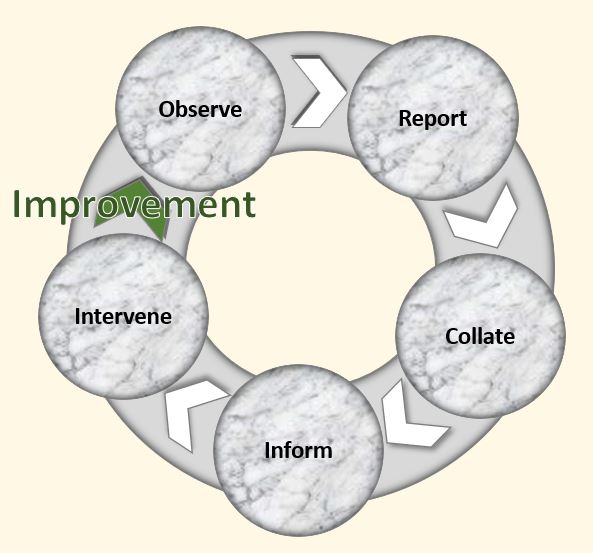
The process would be that someone observes an “unsafe act”, reports it either directly to the person or in a reporting system, there is some form of intervention and an improvement occurs. Note that the intervention doesn’t need to be external, it can be merely that the raising awareness of the risk itself triggers a change in behaviour in the transgressor.

That’s a great theory and makes an interesting read in your Harvard Business Review, but it’s a chicken and egg situation. You can’t realistically engender psychological safety unless you have… created an environment of psychological safety. Even complaining about poor service in a restaurant is uncomfortable for most people. Also, as we’ve discussed, the foundation of major incidents is the culmination of thousands or millions of minor events – it’s too late if you’ve already reached the grievance stage. By the time you’ve reached the point of complaining to the restaurant manager, you’ve probably decided never to come back, no matter how fearless you are in complaining. If we were to reduce these micro-issues by raising them each time, we’d never get any work done and, realistically, we would be labelled “high-maintenance”. This may explain why these utopian workplaces rarely exist outside of the MBA classroom.
The reality requires a more complex improvement cycle of incremental improvements:
This concept of the fearless organisation also pre-supposes that all team members have very high levels of self-awareness and EQ. That’s not always the case. In fact – I don’t think it exists anywhere. We’re all human. Which leads us to why we do require prevention mechanisms…
Why are Prevention mechanisms even necessary?
It’s just common sense, or is it?
I recently wrote a post that read “Sometimes managers just don’t get it – that workplace bullying isn’t just destroying lives, it’s gradually destroying their businesses.”
Someone commented “it’s just common sense”.
But still millions of work days and billions of dollars are being lost due to Qualitosis. So why don’t people show common sense? Could it be that our senses are distorted?
To revert to the tooth analogy, maybe it’s time for some disclosing tablets?

Self-Awareness is a gift
No managers actually want to be bad managers. The problem is that often bad managers think they are good managers. If they think they are already good, why improve, right?
There are several reasons for this. One of the most compelling is that many of us are pre-disposed to be biased in our own favour. And don’t people who think they are better than they actually are, tend to end up being managers? What do they have that we don’t have?
Illusory Superiority
Illusory superiority is a condition of cognitive bias where a person overestimates their own qualities and abilities. For example:
That says to me that 43% of those US respondents must somehow be mildly or grossly deluded. However, illusory superiority doesn’t just apply to motorists. Amongst many other areas it applies in health, IQ, memory, popularity and yes, management.
If 88% of US drivers consider themselves to be safer drivers than the average, what % of managers would consider themselves to be ‘safer’ managers than the others? Let’s consider “safer” to mean less likely to cause an emotional safety incident.
What sort of a manager would erroneously think that he is superior than the average? Probably a manager lacking awareness.
On the chart below (which shows the ascending levels of emotional intelligence), it would likely be managers level 0 & 2 who are weak in Self-Awareness and Social-Awareness.

Level 0 managers would probably agree with my correspondent. It’s common sense that a safe environment is a pre-requisite for an effective team. The problem is that they can’t see that they themselves are the problem and are therefore unable to understand why staff keep underperforming and quitting. It reminds me of the joke, “My father / mother-in law thinks he/she’s a great driver. He/she’s never been in an accident….but he/she’s seen thousands! These managers are the Mr. Magoo’s of Management.

Level 2 managers, however, are quite aware that they can cause damage, but feel that it’s justified if that is how you get the job done. It’s likely these people work in a “performance” incentivised organisation which encourages this approach by recognising whoever finishes first, irrespective of who they have forced off the road in the process. They don’t see the damage they cause as they are often promoted, leaving someone else to pick up the pieces. These managers are the Mr. Toad’s of management.

How do we raise Self-Awareness?
The great thing about Mr. Magoo is that when you fit him with a pair of glasses, his behaviour rapidly changes. Why? Because he suddenly has a new awareness of the reality surrounding him. The mist of delusion lifts.
The same happens with level 0 managers. If you present them with constructive feedback about how they are affecting others, there will likely be a period of reflection followed by a change in behaviour. [For more about why Feedback is so important, please see the blog here.]
Just as physical safety reporting has leveraged advances in technology to improve reporting efficiency, emotional safety reporting systems can use smartphone apps to report to staff on their “safety” indexes. An important aspect here, and something that physical safety has learned, is to focus as much as possible on the positive, celebrating positive behaviours as well as addressing the weaknesses. [For guidelines on designing a successful feedback process see our blog 10 Commandments of Behavioural Feedback Systems.]
Just as companies have raised safety awareness by having a “safety minute” at the start of every meeting, consider having an “emotional safety moment” before each meeting.
The good news is that Self-Awareness is often the easiest of the EQ pillars to improve. The employees are generally only held back by lack of, or by distorted feedback. Therefore, a friendly nudge is often enough. Self Awareness is also the foundation of Emotional Intelligence. Even better news is that all of us, not just level 0 managers, can benefit to some degree from improved self-awareness.
How do we raise Social Awareness?
The bad news about social awareness is that it’s stickier than self- awareness. A lack of consideration for others tends to be hard-wired into certain personalities and therefore harder to improve. If you remember your Wind in the Willows, Toad expresses remorse for his actions when in trouble, but as soon as he’s off the hook he’s back up to his previous exploits.
Feedback to the level 2 manager is often ignored unless it is backed up by tangible actions such as loss of promotion opportunities or missed bonuses. Since the employee is already aware they cause unsafe situations, but does not recognise the consequences, the feedback may need to be “one to one” in order to explain that their approach to achieving personal performance is damaging to the overall team.
Remember the “statement actions” referred to above? There has to be zero tolerance for continued bad behaviour in the workplace, especially if perpetrated by a “high performer”.
There is good news too though. The level 2 employee is a relatively rare bird compared to the other 5 levels. Our experience is that they make up less than 1% of the general workforce and less than 5% of management.
Conclusion
The new era we are entering into for psychosocial safety is similar to the post WWII period of occupational safety improvements where quality data is raising awareness of the astronomical costs of toxic workplace environments.
The arrival of ISO 45003 will increase the profile of emotional safety in the same way that the approval of OSHA did in 1970 in the US.
The improvement curve for emotional safety will be significantly steeper for emotional safety than it was for occupational safety due to lessons learned and the use of new technologies. Laggard companies will swiftly disappear as better workplace information becomes available (e.g. Glassdoor) and a fluid workforce gravitates talent to the companies with better environments.
It’s going to be an exciting period for companies with a pro-active approach to their workplace culture, but a depressing one for companies that are satisfied with the status quo. They won’t last long.
Take Aways
It’s a long Blog this time, so here are a few take aways:
ISO 45003 (Psychological health and safety at work) is on the way
Psychosocial safety in the workplace is a win – win
Don’t reinvent the wheel – Occupational Safety did that already
Safety culture can be learned
Prevention is way better than a cure
Self Awareness through feedback is the foundation of EQ improvement.
If you don’t react now, your company might not be around for long!

 Qualitosis
Leave a reply to How to Reduce “Speeding” and “Aggressive Driving” in the Workplace – Qualitosis Cancel reply